

FTAHK Launches Landmark Position Paper: A Responsible AI Roadmap for Hong Kong’s Financial Services Leadership by 2030
FinTech Association of Hong Kong Launches Landmark Position Paper: A Responsible AI Roadmap for Hong Kong’s Financial Services Leadership by 2030
- The Fintech Association of Hong Kong's Strategic Advisory Council on AI in Financial Services publishes its landmark position paper, drawing on a survey of 103 financial institutions and FinTechs, to chart the city's path to global AI leadership by 2030.
- Paper recognises we are at a critical juncture, and calls for coordinated industry– regulator– educator action to address four key areas: a critical AI talent gap, greater regulatory clarity, data fragmentation, and cross-border data friction.
- Building on the strong support outlined in the HKSAR Government's recently announced budget, the paper maps the conditions needed to attract investment and unlock Hong Kong's next wave of fintech growth.
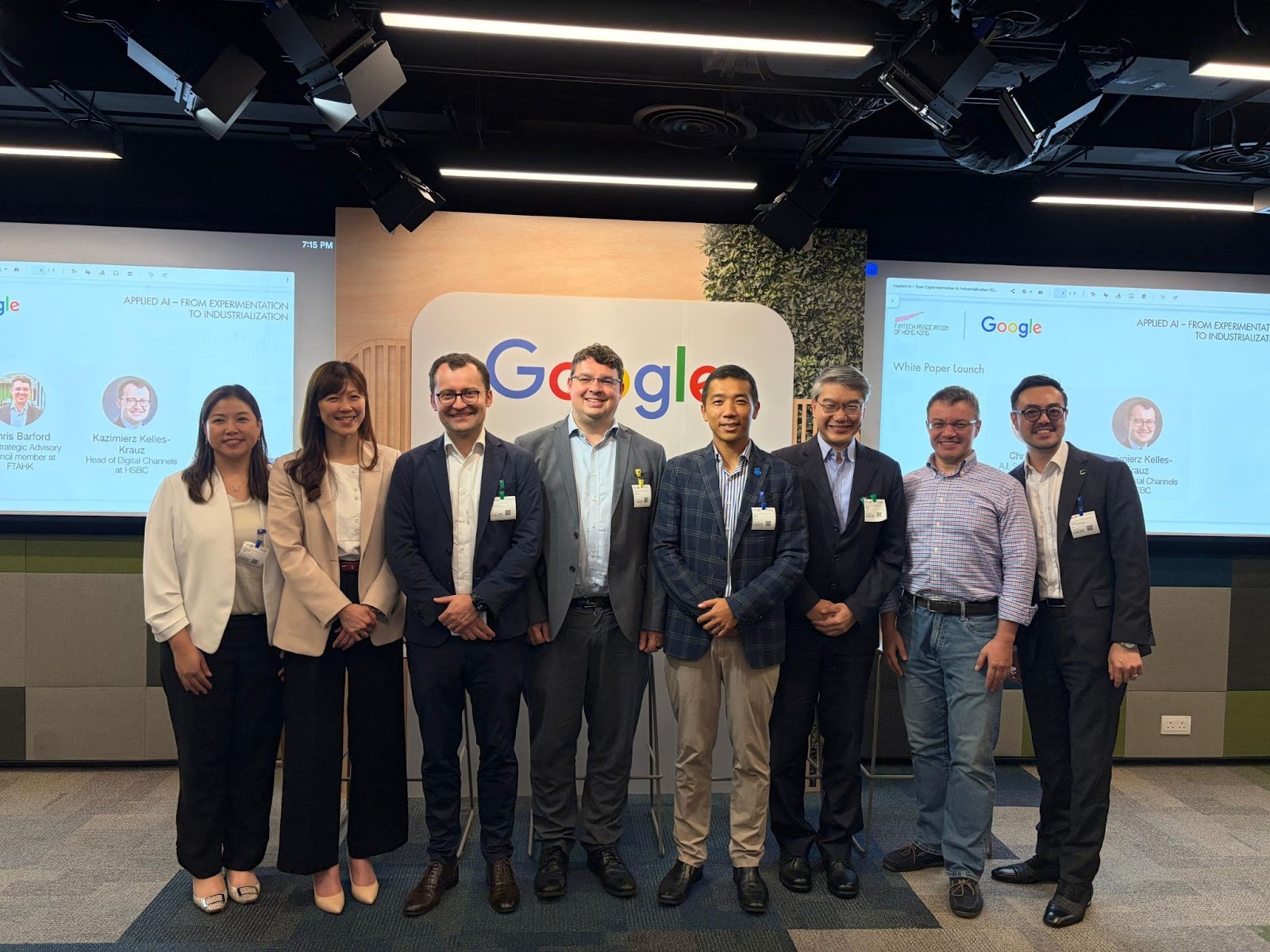
Left to right: Jessica Lam - Chief Strategy Officer (WeLab), Sarah O - Managing Director
Head, Digital Growth & Cards and Unsecured Lending Sales (Citibank Hong Kong), Kazimierz Kelles-Krauz - Board Member (Fintech Association of Hong Kong), Chris Barford -Board Member (Fintech Association of Hong Kong), Garry Sien - Chief Innovation and Solutions Officer, International (Ant Digital Technologies), Brian Tang - LITE Lab@HKU Founding Executive Director (HKU), Maxim Afanasyev - FSI Head for APAC and Japan (Google), Victor Yim - Board Member (Fintech Association of Hong Kong)
HONG KONG – April 2, 2026 – Hong Kong's financial services sector is significantly outpacing the world in artificial intelligence adoption at 38%, yet a convergence of structural weaknesses threatens to undermine that lead, FinTech Association of Hong Kong’s (FTAHK) latest survey finds.
FTAHK’s paper titled “Artificial Intelligence in Financial Services, The Way Forward for Hong Kong,” finds that while the city’s adoption rate significantly exceeds the global average of 26%, a number of challenges must be addressed for Hong Kong to maintain its competitive edge. These include talent shortages, fragmented data infrastructure, regulatory uncertainty, and unresolved ethical concerns.
While most AI deployments currently remain internal and non-customer-facing, the paper identifies four key structural challenges that must be addressed to scale AI into higher-value applications:
To achieve a qualitative leap in AI institutional adoption, the FTAHK Council outlines a comprehensive roadmap with ambitious targets for 2030, including:
- Achieving a 90% AI adoption rate across all financial institutions.
- Attracting HK$8–12 billion in new AI-related angel, venture capital (“VC”), private equity (“PE”) and family office funding.
- Launching over 75 new AI-native financial products and services.
- Securing a top-three global ranking for AI innovation in finance.
The roadmap includes concrete recommendations for all stakeholders. It calls on regulators like the Hong Kong Monetary Authority (HKMA) and the Securities and Futures Commission (SFC) to issue clearer, principles-based guidance on AI model validation and to expand the accessibility of regulatory sandboxes, especially for SMEs. It also urges the government to streamline AI subsidy schemes and to initiate formal dialogues with GBA authorities to facilitate cross-border data flows for AI model training.
To cement Hong Kong’s role as a premier international financial centre, the paper sees that the Greater Bay Area plays a key role. Use cases such as AI-powered hyper-personalised wealth management across the Greater Bay Area, and AI-optimised cross-border payment infrastructure will ensure Hong Kong continues to lead in its AI adoption.
Other use cases to reach Hong Kong’s AI future include:
- Transforming regulatory compliance into a competitive differentiator through AI’s real-time monitoring and predictive breach detection;
- Shifting insurance from a reactive "claim and pay" to a proactive "predict and prevent" model;
- Positioning Hong Kong as a global centre for green finance and ESG analytics;
- Addressing the needs of the city's SMEs through "Cognitive Financial Agents" that offer automated bookkeeping, cash flow forecasting, and tailored financing guidance;
- Developing AI-driven talent training platforms;
- Automating trade finance; and
- Boosting workforce productivity through AI-powered internal assistants.
Moreover, to address the talent challenge, the paper’s roadmap proposes concrete milestones, including establishing partnerships between universities and leading financial institutions to launch pilot AI talent development programs. These aim to train over 200 professionals annually in critical areas such as AI risk management, ethics, and data governance, with the first cohort to be enrolled by the first half of 2027.
“Hong Kong stands at a pivotal moment. Our research confirms we are ahead of the curve in embracing AI, but this lead is fragile,” said Lareina Wang, Chairperson of FinTech Association of Hong Kong. “The decisions we make now regarding AI governance and ecosystem development will determine whether Hong Kong solidifies its role as a premier international financial centre or gets left behind. This paper provides the roadmap for choosing leadership.”
- ENDS -
About the Fintech Association of Hong Kong (FTAHK): The FTAHK is a not-for-profit, independent, member-driven association representing Hong Kong’s vibrant and diverse fintech community. Its mission is to foster innovation, collaboration, and advocacy to position Hong Kong as a leading global fintech hub.
About the FTAHK Strategic Advisory Council on AI in Financial Services:
Chaired by FTAHK current and previous board members Chris Barford & Guillaume Huet, the initiative’s mission is to promote and steer responsible AI adoption by bringing together FTAHK and the broader Hong Kong financial services industry.
The council is made up of the following members for the 2025/26 cohort (in surname alphabetical order):
We also appreciate the assistance provided by students from HKU’s LITE Lab programme, who contributed to some of the primary research of this paper.
Media Contact:
Karen Lee
Associate Director
More Information:
Official Website: https://ftahk.org/
Follow FTAHK on LinkedIn